Product successfully added to your shopping cart
Quantity
Total
Continue shopping Proceed to checkout
New product
Warning: Last items in stock!
Availability date:
| Location | Nürburgring |
| Prints issue | LIMITED EDITION 26 prints ONLY |
| Shooting date | 7 june 1959 |
| Original picture | Negative |
| Formats | Square |
| Formats | Square |
| Era | 1960-1980 |
| Colors | Black&White |
| Collection | Endurance |
| New products | New works |
Motorsport Images has the largest motoring picture collection in the world. The archive houses approximately 18 million images of which in the region of half are black and white negatives and glass plates. The library is made up of images from the world of motor sport since it began and every conceivable road car since it's invention. This incredible archive is the result of the amalgamation of a number of previously separate archives, which are now housed under one roof.
Many of the images are published pictures from the magazines owned and bought by Haymarket over the years and the archive contains the original prints from the very first 'Autocar' issue published in 1895 right through to the present day issue. 'The Motor' archive contains more sporting images with black and white negatives, glass plate and acetate from 1924 - subjects include road cars, sprints, hill climbs, motor shows and Grands Prix.
The original Teesdale Company supplied pictures to 'MotorSport' magazine (founded in 1924) and Motoring News (founded in 1955) and has over 4 million black & white negatives of motor racing events from the 1920's through to the early 1990's. The first colour images appeared in the mid 1950's and 30 years of unpublished 35mm colour images remain in the LAT Black Books. LAT now supplies the Haymarket Media Group, commercial clients, the worldwide media and agencies with motor sport coverage from around the world from Formula 1 to karting.
The 'Autosport' archive contains images from the world's leading motorsport weekly. Since 1950 all aspects of motor racing from Formula 1, Le Mans and sports cars, rallying, single seaters and club racing have been photographed and archived in colour and black and white formats.
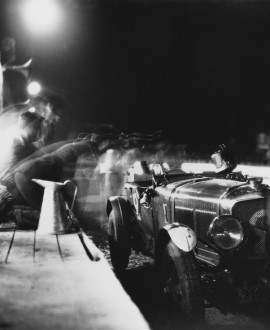
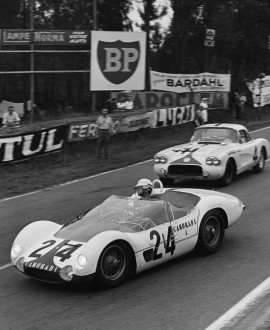
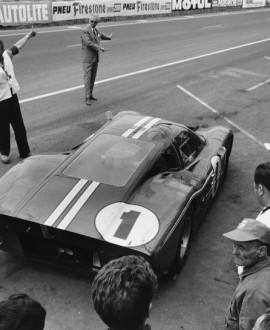
At the 1000km of the Nürburgring, on Sunday, June 7th, a race against time unfolded like few others. The No. 1 Aston Martin DBR1, a 3000cc six-cylinder, saw its two drivers, who shared the wheel, exchange places in a delicate balancing act during a brief pit stop. Jack Fairman had just gone off the track during his short first stint, allowing Phil Hill's Ferrari to take the lead. Stirling Moss, competing privately in the official Aston Martin DBR1, eagerly took the wheel again, rejoining the race more than a minute behind the leading Ferrari.
This was undoubtedly one of Moss's finest races that day, and one of the least known, during the year that nearly saw him crowned Formula 1 champion. Moss would show everyone that he was certainly among the best drivers of the moment since the retirement of the maestro Fangio.
Taking the wheel again, he set off with his rear wheels smoking, chasing down the 250TRs and overtaking them well before the finish line, crossing it victorious with a lead of nearly 20 seconds. This victory contributed significantly to Aston Martin's 1959 World Sportscar Championship title, followed by their historic victory at the 24 Hours of Le Mans a few days later. It is said that the Nürburgring has often been a deciding factor for great drivers, and in Moss's case, who appreciated the "Green Hell" just like Fangio, the English driver's results speak for themselves. The previous year, he had already triumphed with Jack Brabham in an Aston Martin, before once again climbing to the top step of the podium in 1960 with a Maserati Birdcage.